

During facelift consultations at our practice, the most common thing patients say is simple: “I don’t want to look weird.”
I completely understand that feeling. Women and men considering facelift surgery—and other facial rejuvenation procedures—want to look refreshed, but still like themselves. No one wants to look overdone or dramatically different. Most people simply want to look well-rested, vibrant, and natural.
After years of seeing patients come through our practice, I’ve learned that the most natural-looking facelift results come from thoughtful surgical techniques and a conservative philosophy that prioritizes refinement rather than drastic change.
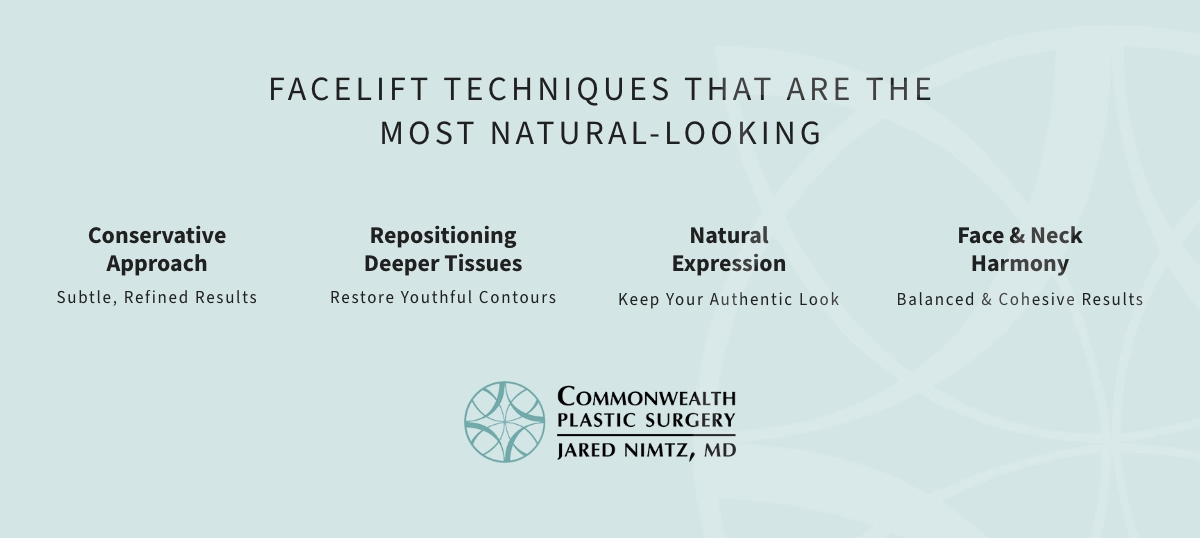
What Does a Conservative Philosophy Mean?
Many people worry that a facelift will make them look tight, artificial, or “done.” That fear often comes from outdated examples of facelift surgery that focused on aggressive skin tightening.
Today, the most natural-looking facelifts are built around a conservative approach to rejuvenation. Instead of dramatically changing the face, the goal is to restore youthful contours while preserving a person’s natural identity.
I approach facelift surgery with this philosophy. During a consultation, I carefully evaluate facial structure, skin quality, and how aging has affected different areas of the face. From there, I develop a personalized plan designed to restore balance and harmony. Instead of using a cookie-cutter approach, I determine the best facelift technique for your specific needs. That may be a Lunch Hour Lift, a modern mini facelift technique I developed.
When the goal is subtle refinement rather than dramatic transformation, the results tend to look far more natural.
Repositioning the Underlying Facial Structures
Another important advancement in facelift techniques involves addressing the deeper layers of the face, not just the skin. Earlier facelift techniques relied primarily on tightening the skin. When skin alone is pulled too tightly, it can create the unnatural “windswept” appearance that patients want to avoid.
Modern approaches focus on repositioning the deeper facial tissues and muscles that sag with age. This deeper layer is called the SMAS
(superficial musculoaponeurotic system). By restoring these underlying structures to a more youthful position, surgeons can improve the contours of the cheeks, jawline, and lower face in a more balanced way.
Once I reposition these deeper tissues, I gently redrape the skin, rather than pulling it tight. This helps the face maintain its natural movement and expression.
In some cases, I may combine a SMAS approach with some deeper facelifting techniques to help smooth the nasolabial folds and tighten the jawline. Whether a SMAS, combination/composite approach or full Deep Plane Face and Necklift, I choose the technique that best suits the patient’s needs and goals for facial restoration.
Preserving Natural Facial Expression
A successful facelift shouldn’t erase your face’s personality.
One hallmark of natural-looking results is the ability to smile, laugh, and express emotion exactly as before. Instead of eliminating every wrinkle or line, the goal is to soften the signs of aging while preserving the characteristics that make a face unique.
Patients often tell us that the best compliment they receive after surgery is when someone says, “You look great—did you change your hair?” In other words, people notice something positive but can’t quite identify what it is. That’s usually the sign of a well-executed procedure and a natural-looking result.
Treating the Face and Neck Together
Maintaining harmony between the lower face and neck is an important component of achieving natural-looking facelift results. As we age, skin laxity often develops along the jawline and beneath the chin. Addressing these areas together by combining your facelift with a neck lift helps restore the smooth, youthful transition between the face and neck.
When the jawline is refined and the neck is tightened in a coordinated way, the overall result tends to look more balanced and natural. Our before and after photos demonstrate this.


Personalization Is Key
No two faces age in the same way, which is why personalization plays such an important role in facelift planning. You may experience early volume loss in the cheeks, while other patients develop jowling or neck laxity first. Skin quality, genetics, and lifestyle all influence how aging appears over time.
That’s why consultations at Commonwealth Plastic Surgery focus on education and individualized planning. Patients can discuss their goals, ask questions, and explore options that best align with their anatomy and lifestyle. For some patients, combining procedures or treatments may provide the most balanced result.
Start With a Consultation
If you’re curious about facelift surgery and want to understand which options may be right for you, the best step is to request a consultation with Dr. Nimtz using the online form or by calling (859) 277-9435. It’s an opportunity to learn more about the process and discover how natural-looking facial rejuvenation can be tailored to your goals.
Leave a Reply